
By Roxie Francis, Founder of I Heart My Voice
Let me describe a singer I meet all the time. She’s got a great voice. Her pitch is clean, her tone is pretty, her breath support is solid, and she’s had years of lessons. She sings a ballad in a room full of people, and everybody nods politely and then goes back to their drinks.
Nothing was wrong with that performance. Nothing was right with it either, because nobody felt anything.
I have coached singers in Los Angeles and online for more than 20 years, and this is the gap I see more than any other. Talented singers are a dime a dozen. The ones people remember can make a stranger feel something in the first line. That skill has almost nothing to do with hitting bigger notes, and it can be learned. This guide shows you how to do it with phrasing, storytelling, and a handful of choices you can start making tonight.
The Short Answer: How Do You Sing a Pop Song Emotionally?
To sing a pop song emotionally, decide what the song is about for you and who you are singing to, then shape every line like a sentence you mean. Use phrasing to control where you breathe, which words you lean on, and when you hold back, and use dynamics and tone to match the feeling of each section. Emotion in singing comes from clear choices, and big vocals do not create it by themselves.
Here is the process in brief:
Speak the lyric out loud before you sing a single note.
Decide who you are talking to and what you want from them.
Map the emotional arc of the song from the first line to the last.
Phrase every line like a sentence, with purpose behind each breath.
Stress the words that carry the meaning and let the others pass.
Use dynamics and tone to show the feeling instead of announcing it.
Use silence, breath, and your body as part of the story.
Stop oversinging so the listener has room to feel something.
Record yourself, listen like a stranger, and adjust.
The rest of this guide explains each step with examples you can try right away.

Why Technically Good Singers Leave People Cold
Most singers learn songs as a string of notes. You learn the melody, you learn the words that go with it, and you practice until the notes come out clean. That process works for getting the song in your body, and it also teaches your brain to treat the lyric as a delivery system for pitch.
Listeners do not hear a song that way. They hear a person telling them something. When a singer treats words as pitches, the audience senses it, even if they cannot say why, and they start checking the time.
Think about how you talk when something matters. You slow down on the words that hurt. You speed up when you are excited. You stop in the middle of a sentence because you cannot finish it. You say a word softer than the rest because it costs you something to say it. Nobody teaches you any of that, and it happens because you mean what you say.
Singing with emotion means bringing that same behavior into the melody. Your technique then becomes the vehicle for a human being telling the truth, and the notes stop being the point.
The singers who stand out on shows like American Idol and The Voice have this quality. The coaches and clients on our team who have become finalists did not get there by being the loudest or the most technical in the room. They stood out because they capitalized on what makes them unique, and they found songs and delivery choices that let a listener feel who they are.

Emotion Is a Choice You Make in Rehearsal
Singers worry about this one a lot, so let me clear it up. You do not need to feel a giant wave of emotion every time you perform. You also should not wait to feel inspired.
Professional singers sing the same song hundreds of times, in tired rooms, on bad days, with a head cold. They deliver the feeling on purpose, because they made the choices in rehearsal and they repeat them with intention. The feeling can be real, and the choices are what make it repeatable.
There is also a trap on the other side. Some singers confuse emotion with acting sad. They add a wobble, a sniffle, a dramatic scoop on every line, and a pained face, and they call it feeling. Listeners can smell that from the back row. Real emotion in a performance is usually quieter and more specific than the fake version.
One more thing worth knowing. If you let yourself get so emotional that your throat tightens and your voice cracks, you lose control of the song. Your job is to carry the feeling to the audience, and you cannot do that if you are drowning in it. Feel it, then steer it.

Step 1: Speak the Lyric Before You Sing It
This is the simplest step and the one singers skip most often. Before you sing a note, read the lyric out loud as if you were telling a friend what happened.
Do it three times. Say it flat the first time, just to hear the words. Say it the second time the way you would say it to a person you love. Say it the third time like you are trying to convince someone who does not believe you.
Pay attention to where your voice naturally speeds up, slows down, rises, falls, or drops to almost nothing. Those instincts are your phrasing. The melody gives you the notes, and the speaking voice shows you where the meaning lives.
Mark up your lyric sheet while you do this. Underline the words you leaned on. Put a slash where you naturally paused. Circle any word that surprised you with how much weight it carried. You will use all of it in the next steps.
Step 2: Know Who You Are Talking To and What You Want
Actors use a tool that works beautifully for singers. Before a scene, they decide who they are talking to and what they want from that person. They write it as a verb, such as to comfort, to dare, to apologize, to beg, to forgive, or to let go.
Try it with your song. Pick one person you are singing to, and make it specific. Maybe it is an ex who never apologized, a friend you let down, a parent you finally understand, or your younger self. Then pick one verb for what you want from them.
Write it in a sentence at the top of your lyric sheet, such as “I am trying to convince him I am fine when I am not.” That sentence is the engine of your performance, and it does a lot of the work for you. It tells you whether a line should be tender or sharp, whether you stare into the distance or hold the eye contact, and whether you are open or guarded.
If you read our guide on how to make a cover song your own, you will recognize this step. Finding your point of view is where a performance begins, and phrasing is how you deliver it.

Step 3: Map the Emotional Arc
A song is a short story. Most pop songs follow a shape, and your delivery should follow it too, because a performance that stays at one emotional temperature all the way through feels flat.
Break your song into sections and write one word next to each, describing the feeling.
The first verse sets the scene. It is usually the most conversational part of the song, and it wants you close, quiet, and specific. Tell us what happened.
The pre-chorus builds tension. Something is about to give, and your phrasing can start to tighten, push forward, or lean in.
The chorus is the emotional statement. This is where the central feeling gets said out loud, and it can be big, bitter, joyful, or heartbreakingly small. The chorus does not have to be loud to land.
The second verse deepens the story. It should not be a copy of the first one, so find what is different about it. Maybe you know something now that you did not know before.
The bridge is the turn. The truth shows up here. The bridge often has the biggest shift in the song, so give the listener something new, whether it is a drop to almost nothing or a sudden burst of honesty.
The final chorus is the same words with a different meaning. By now the listener has traveled with you, so the same line should carry more weight than it did the first time.
Now give each section a rating from 1 to 10 for intensity and write it in the margin. Most singers find they have been performing the whole song at a 7. When you give yourself a map that moves from a 3 to a 5 to an 8 to a 2 and back to a 9, the song starts to feel alive.

Step 4: Phrase Every Line Like a Sentence
Phrasing is the way you shape the melody and the words in time. It covers where you breathe, how long you hold each note, when you start a line, how you end it, and which words you lean on. Two singers can sing the exact same notes and sound completely different, and phrasing is almost always the reason.
The most useful rule I teach is simple. Treat every line of a song as a sentence, and treat every breath as a thought. Your listener needs to hear complete ideas, and chopping a sentence in half because you ran out of air or because a bar line told you to breaks the meaning.
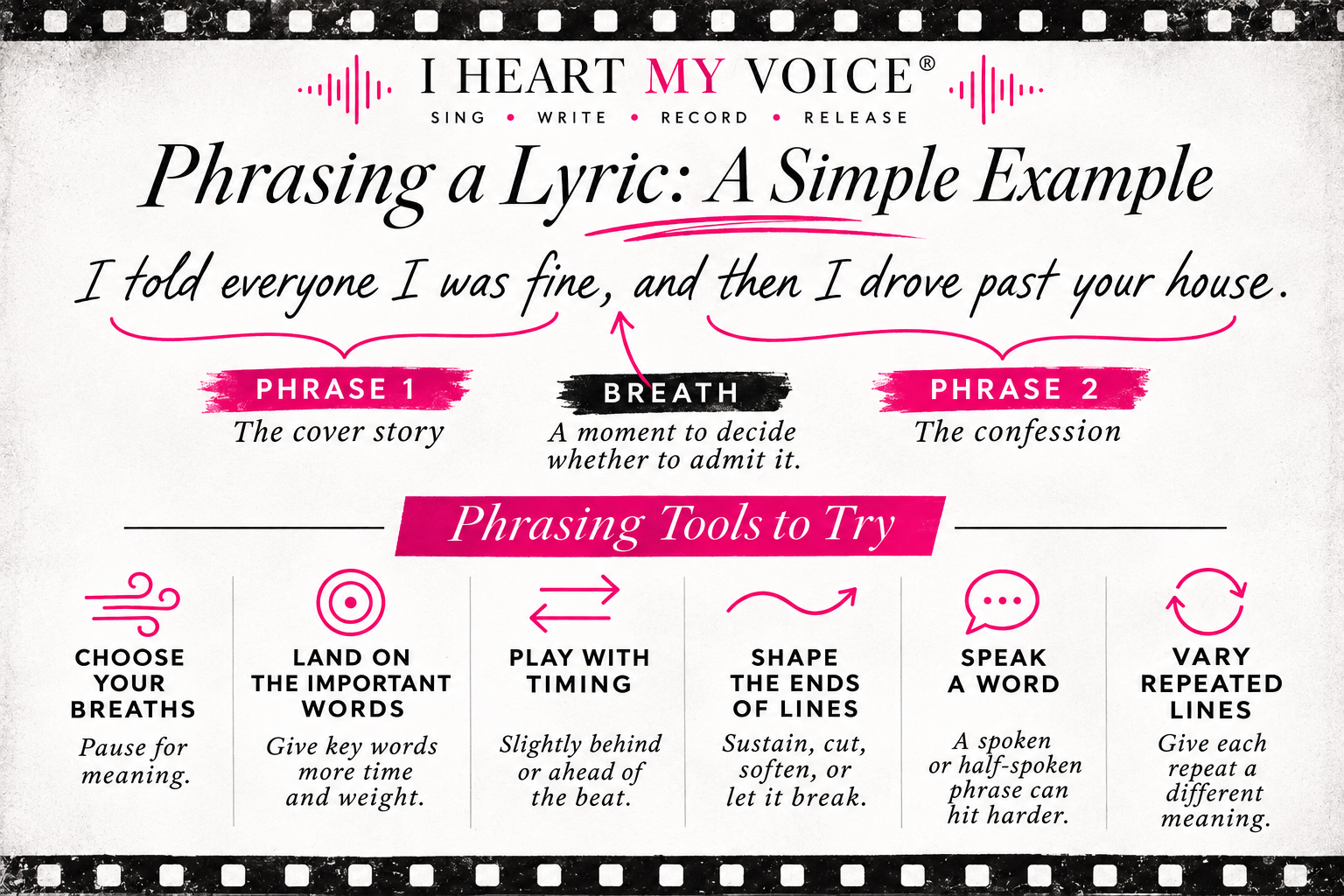
Here is a quick example. Imagine a line I just made up: “I told everyone I was fine, and then I drove past your house.”
A singer who is focused on the notes might breathe after “everyone” because the melody has a gap there. A singer who is telling a story would take the breath after “fine,” because the line has two parts. The first part is the cover story, and the second part is the confession, and the breath is the small pause where you decide whether to admit it. That tiny choice changes what the audience hears.
Here are phrasing tools you can use on any song:
Choose your breaths for meaning. Place each breath where a person would naturally pause to think, and avoid breaths that cut a phrase in half.
Land on the important words. Decide which one or two words in each line carry the meaning, then give them more time, more weight, or more color, and let the little words rush past.
Play with timing. Singing slightly behind the beat can sound relaxed, tired, or confident, and singing slightly ahead can sound urgent or nervous. Pick the one that matches the feeling.
Shape the ends of lines. You can sustain a word until it fades, cut it short, let it drop softly, or let it break a little. How you leave a line is one of the strongest emotional choices you have.
Speak a word. Dropping into a spoken or half-spoken delivery on one phrase makes the sung lines around it hit harder.
Vary repeated lines. If a lyric repeats, give it a different meaning every time. The third “stay” should not sound like the first one.
Your phrasing should still respect the song. Keep the hook recognizable, and use the original melody as your anchor. If you want help choosing a key that gives you room to phrase with ease, read our guide on how to pick the right key for your voice, because a strained key makes expressive phrasing almost impossible.
Step 5: Stress the Right Words
Every line has a few words that carry the meaning and a handful that glue the sentence together. Singers who sound robotic usually give every word the same weight.
Go back to your lyric sheet and circle the key words in each line. In “I told everyone I was fine,” the word that matters most is probably “fine,” because it is the lie. In “I drove past your house,” the heart of the line might be “your,” because it is about him, or “drove,” because of the effort. You get to decide, and the choice changes the story.
Then try these ways of leaning on a word:
Hold it a little longer than the rhythm calls for.
Sing it a touch louder or softer than the words around it.
Add a slight breath or a tiny pause right before it.
Change the tone, such as a bit of air, a bit of grit, or a rounder vowel.
Let your voice drop or rise on it.
Do not decorate every word, because stressing everything is the same as stressing nothing. Pick one or two per line and trust the rest to do their job.

Step 6: Let Dynamics and Tone Show the Feeling
Loud does not mean emotional. Some of the most devastating performances in pop music are quiet, and some of the loudest performances leave listeners feeling nothing.
Dynamics, the changes in volume, create the shape of the story. A whisper before a big line makes the big line larger. A held silence before the last word of the chorus makes everyone lean in. Pulling back at the moment people expect you to belt can be the thing that gets you remembered.
Tone does just as much. Your voice has a natural color, which we call timbre, and the emotional temperature of a song often lives in the tone. A breathy, close sound feels intimate and vulnerable. A bright, forward sound feels hopeful or defiant. A darker sound feels heavy, mysterious, or tender. A touch of rasp on a single word can say something a thousand notes cannot.
If you want to understand your own natural color before you start shaping it, read our guide to vocal tone and timbre. Knowing what your voice does naturally gives you a palette to work from.

Step 7: Use Breath, Silence, and Your Body
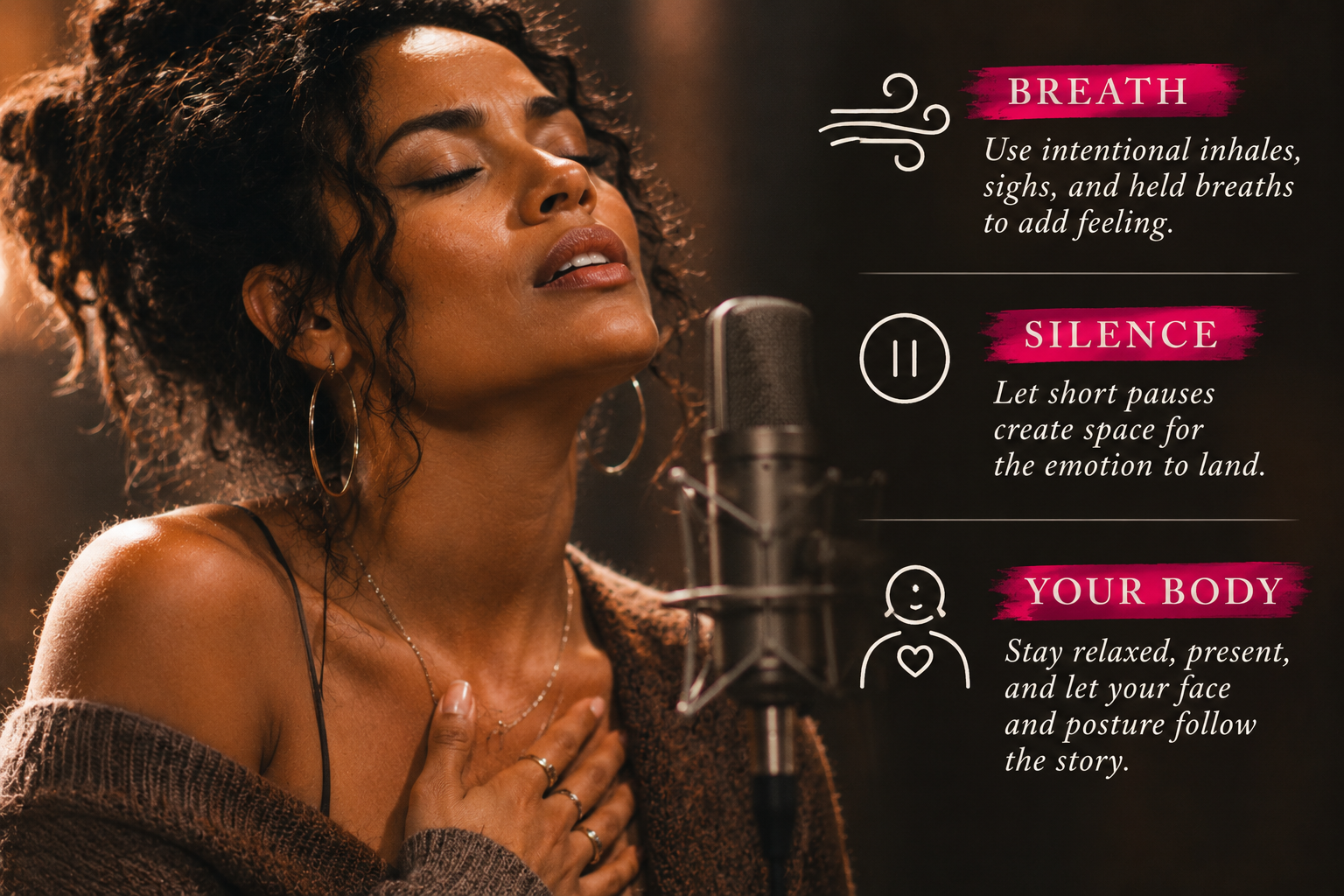
Listeners feel breath. A small, audible inhale before a line tells them you are about to say something that matters. A sigh before the chorus tells them you are tired of pretending. A held breath before the last word tells them it is hard to say.
Pop music, especially with close microphones, rewards this kind of detail, so do not scrub every breath out of your performance. Place them on purpose.
Silence works the same way. A pause between two lines gives the audience time to feel what you just said, and singers who rush to fill every gap miss the best moments in the song. Try leaving one half-second of space before the most important line of your song, and watch what a room does.
Your body matters too, even in a recording booth. If your jaw is clenched, your shoulders are up, and your eyes are glued to a lyric sheet, your voice carries that tension, and the listener hears a person who is not present. Let your face and posture follow the story. You do not need dramatic gestures, since small physical choices can change your sound, and the audience will read your face before they hear your first note.
Step 8: Stop Oversinging
This is the habit I most want to retire. Oversinging happens when a singer packs every line with runs, belts, scoops, vibrato, and vocal tricks to prove they are good. It makes the singer look busy and makes the song hard to feel.
Here is what oversinging usually looks like:
Adding a riff to every line.
Belting the chorus at full volume from the first repeat.
Using the same vocal effect, such as a growl or a scoop, on every phrase.
Singing so big that the lyric disappears.
Treating a quiet song like a competition.
Listeners cannot connect with a performance that never lets them in. The singers who move people have confidence in a plain line. They let one honest, simple note carry the weight and save the big moves for the moment that earns them.
Our guide on the pop star vocal habits that can ruin your voice covers why copying tricks from famous singers can hurt your sound and your voice at the same time.

Working Through a Line Together
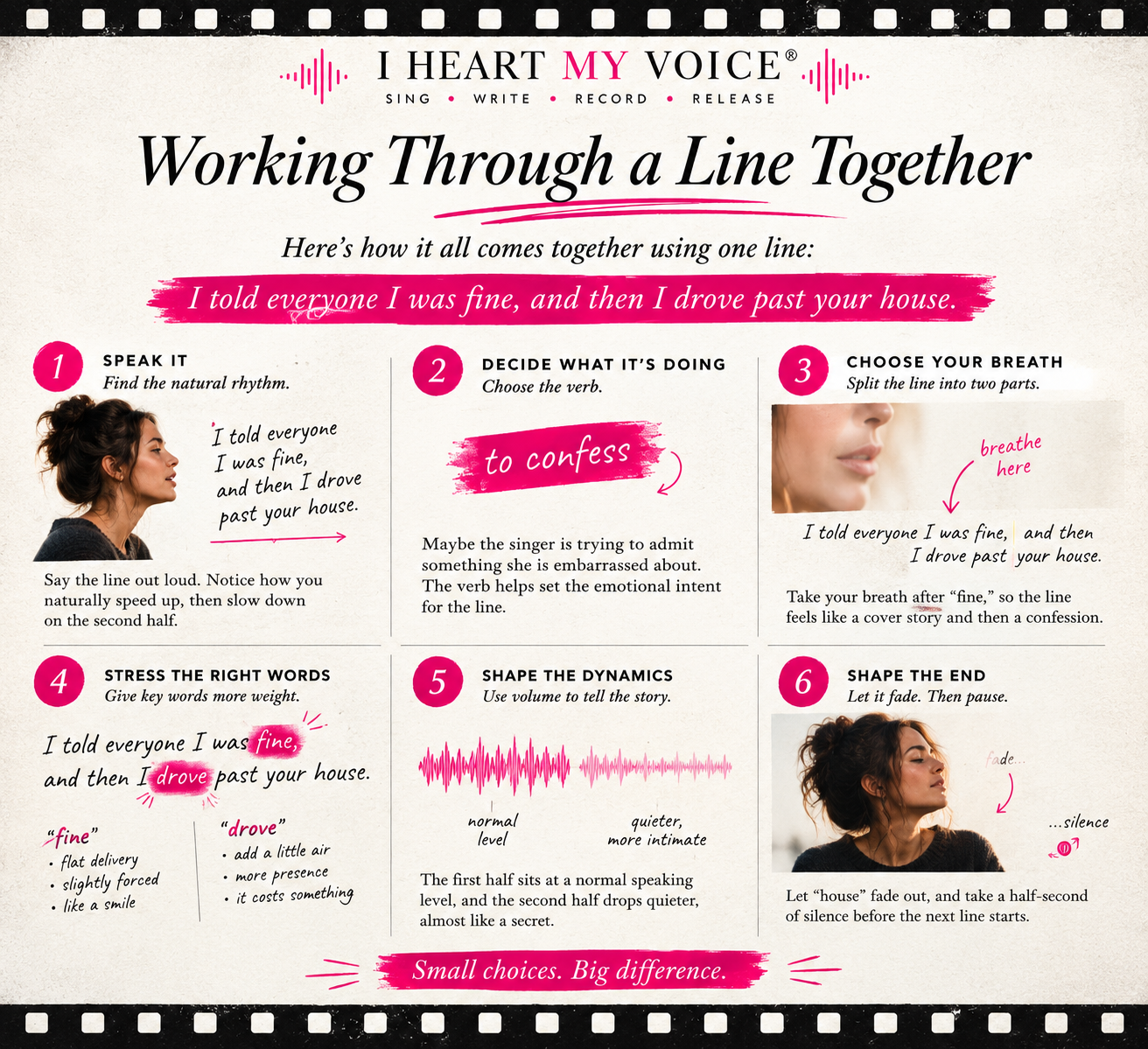
Here is how it looks when you put the steps together on a single made-up line, using the same lyric from earlier: “I told everyone I was fine, and then I drove past your house.”
First, I would speak it. In a normal voice, I would probably say the first half quickly, like a throwaway, and slow down on the second half.
Second, I would decide what the line is doing. Maybe the singer is trying to admit something she is embarrassed about, so the verb is “to confess.”
Third, I would choose the breath after “fine,” as we talked about, so the line splits into the cover story and the confession.
Fourth, I would choose the stressed words. “Fine” gets a flat, slightly forced delivery, like a smile that does not reach the eyes. “Drove” gets a little more air, because it costs something to say.
Fifth, I would shape the dynamics. The first half sits at a normal speaking level, and the second half drops quieter, almost like I am telling a secret.
Sixth, I would shape the end of the line. I might let “house” fade out quietly, and take a half-second of silence before the next line starts.
None of that required a bigger voice or a harder note. It was a series of small choices, and together they turn a line of lyrics into a moment.
Common Mistakes That Keep a Performance Flat
Let’s talk about the habits that make people check their phones mid-song. I see these every week.
Mistake 1: You sing words you don’t understand.
If you can’t explain a line in your own words, nobody else will feel it. Natalia P., one of our Find Your Voice singers, put it perfectly: “Now I have the tools to go through a song and figure out how I want to sing it.” Start there.
Mistake 2: You breathe where the music tells you to.
Your breath belongs where the thought ends. Follow the sentence and the song will follow you.
Mistake 3: You perform everything at one temperature.
A whole song at a 7 is a very pretty wall. Give it peaks and valleys.
Mistake 4: You fake it with vocal tricks.
A forced sob or a staged crack reads as acting from the back row. Let the lyric make the choices.
Mistake 5: You cry your way through it.
Feel it, then steer it. You can’t carry a feeling to an audience while you’re drowning in it.
Mistake 6: You rush the silence.
Dead air feels scary to singers. It also happens to be the part people remember.
Mistake 7: You copy the original singer’s phrasing.
Their choices fit their story. Make your own, because your version only becomes yours when you stop borrowing theirs.
Mistake 8: You sing in a key that strains you.
When reaching the notes takes everything you’ve got, there’s nothing left for the story.

Phrasing and Storytelling for Auditions and Shows
You get about 60 to 90 seconds in most auditions. That’s not much time to warm up a room.
So start the story with your first line. Pick the juiciest section of the song, know who you’re singing to, and commit before you open your mouth.
Panels hear dozens of singers who nail the notes. They remember the one who made them lean in.
Amanda L. knows this better than most. She came to us frozen with fear. In her words: “My whole body would freeze. My confidence was in the trash.” Now she’s booked a national Rally’s singing commercial, and she calls it “a 180 degree turn.”
Nerves pull you back toward the notes and away from the story. Practice your choices until they live in your body, and they’ll show up even when your heart is pounding.
Want the practical side? Read how to prepare for a singing audition and what makes a pop vocal performance stand out.
Still picking your song? The right one makes emotion so much easier. Here’s how to choose songs that show off your voice.

A 20-Minute Practice Routine for Emotional Delivery
Grab any song you’re working on and set a timer.
Minutes 1 to 3: Speak the lyric three ways. Say it flat, then tender, then like you’re convincing someone who doesn’t believe you. Mark where your voice pauses and leans.
Minutes 4 to 6: Write down who you’re talking to and what you want from them. Then write one sentence about what the song means to you.
Minutes 7 to 9: Map the sections. Give each one a feeling and an intensity from 1 to 10. Circle your biggest moment and your quietest.
Minutes 10 to 13: Sing at half volume. Focus only on breaths, stressed words, and how each line ends.
Minutes 14 to 17: Sing it again with full intention and record it.
Minutes 18 to 20: Play it back. Mark where you felt something, where you slipped into “just singing notes,” and where you oversang.
Do this on five songs and you’ll start to see your own signature. That’s your style showing up.
Try the stranger test too. Play a take for someone who’s never heard the song and ask what it’s about. If they say something close to your intention, the story is landing.

Going Beyond Scales: How a Coach Helps You Find Your Story
Maybe you’ve had lessons. Maybe your technique is solid and you still don’t sound like an artist when you perform.
Technique tells you how to sing the notes. Artistry tells people why they should care. Those are two different skills.
Here’s what happens when singers get both. Alina K. told us, “I found my wow factor and my belt. I’ve learned how to paint any song I want with the tools I’ve learned.” Her cover pulled 550K views on YouTube and 300K on Instagram.
Jane M. said it this way: “I Heart My Voice has been life-changing for my confidence and grace as a singer. It’s amazing how specific and knowledgeable the team is with technique.”
✨ Ready for that? Check out our Find Your Voice program. ✨
Your coaching team helps you find what makes your voice unique. You’ll choose songs that show off your superpowers and build the phrasing, tone, and storytelling that make people feel something. Our coaches are working pros, including finalists from American Idol, The Voice, and X-Factor.
Our studio motto says it all: “No one will ever be better at being you and sounding like you than you, and that is your gift.”
Your stories, your instincts, and the way you phrase a line belong to you. Nobody else has them.
✔️ Want to see how it works in LA? Read about finding your voice in LA.
✔️ Feel stuck? Read why singers fail to grow.
You can train with our team in person if you’re looking for a vocal coach in Los Angeles, or you can train online and get the same personal attention.

FAQs:
-
Speak the lyric out loud, then decide who you’re talking to and what you want from them. Place your breaths where a thought ends, lean on the key words, and use soft and loud moments to match the feeling.
-
Phrasing is how you shape the melody and words over time. It covers where you breathe, which words you stress, how you hold notes, and how you start and end each line.
-
Robotic singing comes from giving every word the same weight. Mark the words that carry the meaning and breathe where a person would naturally pause. Then vary your volume and timing on those key words.
-
Put the lyric in your own words and pick one person you’re singing to. Write a single sentence about what the song means to you and keep it in mind while you sing.
-
Yes. Emotional singing is a set of skills, including phrasing, dynamics, tone, breath, and storytelling. You can practice every one of them, and many of the most moving singers keep their delivery quiet and simple.
-
No. Pros deliver emotion through choices they rehearsed, and they stay in control while they do it. If your throat tightens and your voice cracks, you’ve lost the steering wheel.
-
Start with the lyric spoken as a sentence and place your breaths where the thought ends. Choose one or two meaningful words per line, then vary repeated lines so each one means something new. Keep the hook recognizable.
-
Rhythm is the timing written into the song. Phrasing is how you shape the line around that timing, including breath, emphasis, and how you land on or leave each note.
-
Yes. A coach hears where your delivery goes flat and shows you how to place breaths and stress for meaning. At I Heart My Voice, building your story, style, and sound is the heart of our Find Your Voice program.
❤️ Final Word from Roxie
Ready to Sound Like Nobody Else?
You already have a voice and a story nobody can copy. Phrasing them with intention turns a nice performance into a moment people remember.
Taken lessons and ready for coaching that builds style, brand, and mastery?
➡️ Apply for the Find Your Voice program and let’s build a sound only you can make.
With love,
Roxie

At I Heart My Voice, we help singers unlock their full potential through online singing lessons, vocal coaching, and artist development programs.
Whether you’re just starting out or ready to go pro, our award-winning team has guided singers to Broadway, Disney, Nickelodeon, major labels, and viral success.