
By Roxie Francis, Founder of I Heart My Voice
Talented singers are a dime a dozen. Every audition room, open mic, and talent show is full of people who can hit the notes, and a cover song is where most of them start to blend together.
If you have already taken lessons, you probably know this feeling well. You sing in tune, you have done the scales, and a teacher has fixed your breath support. Yet when you perform a song people already know, you still sound like a pleasant version of the original. That vanilla feeling usually comes from singing a song the way it was already sung, with no point of view of your own.
I have coached singers in Los Angeles and online for more than 20 years, and I can tell you that the singers who get remembered treat a cover as a chance to introduce themselves. This guide shows you exactly how to do that, step by step, from choosing the song to adding the one moment that people will talk about afterward.
The Short Answer: How Do You Make a Cover Song Your Own?
To make a cover song your own, choose a song that fits your voice and your story, then change at least two or three elements of the original, such as the key, the tempo, the phrasing, the tone, or the arrangement, while keeping the melody and the hook recognizable. Then sing it from your own point of view, so the lyric sounds like something that happened to you.
Here is the process in brief:
Choose a song that fits your natural strengths and your story.
Learn the original well, then put it away so you stop imitating it.
Decide what the song means to you and who you are singing to.
Pick a key that shows off your best tone.
Change the tempo or the feel.
Rework the phrasing and place your ad-libs with purpose.
Shape your tone and dynamics to match your point of view.
Reimagine the arrangement.
Add one signature moment that belongs only to you.
The rest of this guide explains each step and shows you how to practice it.

Why Most Cover Songs Sound Like Everyone Else
Most singers learn a cover by copying. They play the original on repeat, match every run, and copy the quirks of the famous singer’s voice. That is a useful way to learn a song, and it is a poor way to perform one.
When you imitate, your listener compares you to the original in real time, and the original wins almost every time. You are standing next to a singer with a full production, a studio, and years of brand recognition behind them. A copy has nothing to offer that the real recording does not already provide.
The singers who stand out do something different. The coaches and clients on our team who have become finalists on shows like American Idol and The Voice stood out because they capitalized on what makes them unique. Those shows reward singers who find the right songs to capture their superpowers, whether that is their tone, their style, or their story. A cover song becomes the vehicle for that, and the singer becomes the point.

Three Kinds of Covers, and the One to Aim For
Before you start, decide how far from the original you want to travel. Most covers fall into one of three types.
The tribute stays close to the original in key, tempo, and arrangement. It works well for a wedding band or a cover night, and it shows skill, but it rarely shows personality.
The interpretation keeps the song’s basic structure and melody but changes the phrasing, tone, emotional angle, and often the key. This is the sweet spot for most singers, because listeners can still recognize the song and also hear a person behind it.
The reinvention transforms the song into something new, often in a different genre or with a different groove. Johnny Cash’s version of “Hurt,” originally by Nine Inch Nails, is a famous example, as is Aretha Franklin’s “Respect,” which Otis Redding wrote, and Whitney Houston’s “I Will Always Love You,” which Dolly Parton wrote. Each of those covers became the version most people think of first.
My advice is to aim for an interpretation and add one reinvention move, such as a new tempo or a stripped-down arrangement. That combination keeps your audience with you while giving them something fresh.

Step 1: Choose a Song That Fits Your Superpowers
Everything else in this guide gets easier when you start with the right song. A song that fits you will let you make bold choices with confidence, and a song that fights you will keep you imitating.
Ask yourself these questions when you choose:
Does the lyric match a story I can tell? A song you believe in gives you something real to sing about, and your tone follows your intention.
Does the song show off my best qualities? If your strength is a warm, smoky low range, a song that lives in a bright, high belt will make you work against yourself.
Does it fit my style? Choose songs that sit near the genre you want to be known for, then bend them toward your own sound.
Is the song overdone? Songs that every singer in town performs make comparisons easy. If you love one, make sure your angle is different enough to be memorable.
I cover this decision in depth in our guide on how to choose songs that show off your voice and it pairs naturally with this one. Matching the right song to your natural strengths is also a core part of our Find Your Voice program. where your coaching team helps you build a repertoire that sounds like you.

Step 2: Learn the Original, Then Put It Away
You need to know the song thoroughly before you can change it. Listen to the original several times, and then find two or three other versions by different artists. Seeing how other singers handled the same melody shows you how much freedom a song actually allows.
As you listen, take notes on three things. First, write down the structure, including the verses, pre-chorus, chorus, bridge, and any instrumental breaks. Second, identify the hook, which is the melody and lyric that make the song recognizable. Third, mark the moments you love, because those often point to what you will want to keep or build on.
Then stop listening. Learn the lyrics and the melody from a lead sheet or from your notes, and give yourself a few days without the recording. If you keep the original in your ears, your voice will drift back toward its phrasing and its vocal habits without you noticing.
This step also protects your voice. Singers who copy the tone of a famous artist often push their bodies into shapes that do not suit them, and I have written about the pop star vocal habits that can ruin your voice for exactly that reason.

Step 3: Find Your Point of View
This step separates a good cover from a memorable one, and most singers skip it. Before you change a single note, decide what the song means to you.
Try this exercise. Record a voice memo in which you speak the lyric out loud in your own words, as if you were telling a friend the story. Who are you talking to? What happened right before this moment? What do you want them to understand? Then write one sentence that sums up your version of the song, such as “I am finally letting go of someone I still love.”
That sentence becomes your compass for every choice that follows. It tells you whether a line should be whispered or declared, whether to rush or linger, and where to hold back. Delivery that comes from a clear intention sounds natural, because your breath, tension, and tone adjust to match the feeling. Our guide on vocal tone and timbre explains why emotion is one of the fastest ways to change the color of your voice.

Step 4: Choose a Key That Shows Off Your Best Tone
The original key suits the original singer. It may not suit you, and the best key for a cover is rarely the one on the recording.
Try the song a half step or a whole step up and down, and listen for where your voice sounds richest. Many singers assume that higher is more impressive, and the opposite is often true. A key that lets you sing the chorus at a comfortable level lets you color the words, while a key that makes you strain turns every phrase into a technical challenge.
Moving a song lower can bring out warmth and intimacy, and moving it higher can add urgency and brightness. Both are legitimate choices, as long as you can deliver the notes without squeezing. If anything hurts, stop and lower the key. We are also preparing a full guide on picking the right key for your voice, and you will find it linked here once it is live.

Step 5: Change the Tempo and the Feel
Tempo and groove change the personality of a song faster than almost any other choice. A song that feels frantic at its original speed can become devastating when you slow it down, and a ballad can become playful with a lighter rhythm.
Experiment with a few approaches:
Slow it down. A slower tempo gives you room to linger on words, add silence, and let the emotion breathe.
Speed it up. A brighter tempo can turn a sad song into a defiant one, which gives the lyric a completely new meaning.
Change the rhythmic feel. Try a swung feel, a half-time groove, a waltz, or a loose, conversational pulse.
Strip the groove away. Sing the verse in free time, almost like speaking, and bring the beat in at the chorus.
Record yourself at three different tempos and listen back. One of them will usually sound like you.

Step 6: Rework the Phrasing
Phrasing is the way you shape the melody and the words in time, and it is where most of your personality lives. Two singers can use the same notes and sound completely different because of when they start a line, where they breathe, and which words they stress.
Here are phrasing tools you can use right away:
Sing behind or ahead of the beat. Landing slightly late creates a relaxed, confident feel, and landing slightly early adds urgency.
Choose which words to land on. Decide which words carry the meaning and give them weight, then let the others pass quickly.
Move your breaths. A breath in an unexpected place can create tension or vulnerability.
Speak a line. Delivering one phrase in a conversational, almost spoken way makes the sung lines around it hit harder.
Change the ends of phrases. Sustain a note longer, cut it short, or drop it into a different pitch to leave your mark without losing the melody.
Keep the hook intact, because it is what makes the song recognizable. A good rule of thumb I share with singers is to stay close to the original melody in the first chorus, then personalize more in the second chorus and the final chorus, after the listener has settled in.
Place your ad-libs and runs with purpose as well. Many singers decorate every line, and that habit makes a performance sound busy and generic. One well-placed ad-lib per section usually does more than a constant flow of runs.

Step 7: Shape Your Tone and Dynamics
Your voice has a natural color, which we call timbre, and your cover is the place to show it off. Decide how you want the tone to move through the song. You might start breathy and close in the verse, then open into a full, clear sound in the chorus. You might use a touch of rasp on a single word to add grit exactly where the lyric calls for it.
Dynamics, which are the changes in volume, give the song a shape. A performance sung at one level the whole way through feels flat, even when the notes are perfect. Contrast between soft and loud, tight and open, and spoken and sung gives the listener a journey. If you want to understand your own natural color before you shape it, start with our guide to vocal tone and timbre.

Step 8: Reimagine the Arrangement
If you perform with a track, a band, or an instrument, the arrangement offers some of your biggest creative opportunities. You can reshape the song without changing a single lyric.
Consider these ideas:
Change the instrumentation. A song built on a big production can become intimate with just piano or acoustic guitar.
Flip the genre. Imagine an R&B hit as an acoustic country ballad or a rock anthem as a jazz ballad.
Rewrite the intro and outro. A new opening hook or a quiet, unexpected ending gives the song your signature at both ends.
Add vocal layers. Stacked harmonies or a looped vocal bed can create a sound that belongs to you.
Use space. A sudden stop or a held pause before the last chorus can create real drama.
If you work with other musicians, bring them a clear idea of the mood you want. Describing the feeling is often more useful than describing the notes.

Step 9: Add One Signature Moment
A great cover usually has one moment that a listener remembers and describes to a friend. It might be a spoken line before the last chorus, a held silence, a surprising note, or a tag at the end that changes the meaning of the lyric.
Plan this moment on purpose. Decide where it will happen, what it will be, and how you will set it up. One strong choice carries more weight than five small ones, and it gives your listener something to hold onto.
Same Song, Four Makeovers
Here is how one imaginary pop ballad could take on four different personalities with the steps above.
The intimate version drops a whole step, slows down, and uses only a piano, with a breathy, close-to-the-microphone tone.
The soulful version adds a gospel-inspired groove, stretches the phrases behind the beat, and builds into a full-voiced final chorus.
The acoustic country version moves to guitar, brightens the tempo, and adds a light twang on the vowels.
The late-night jazz version swings the rhythm, spaces the melody with long pauses, and treats the lyric almost like a spoken confession.
All four versions would still be recognizable as the same song, and each one would sound like a different artist. That range comes from your choices, and your choices come from knowing who you are as a singer.

Mistakes That Keep a Cover Sounding Vanilla
Singers who are already skilled often fall into the same traps. Watch for these:
Copying runs note for note. If you sing the original singer’s ad-libs exactly, listeners hear an impression and not an artist.
Changing everything at once. If the key, tempo, melody, and arrangement all change, the song loses the thread that makes it a cover, and your audience loses the connection.
Singing the words without a point of view. Perfect technique cannot make up for a lyric you do not mean.
Staying in the wrong key. A key that strains you forces you to focus on survival and leaves no room for style.
Riffing everywhere. Constant decoration hides the melody and tires the listener.
Ignoring the room. A big, belted version might thrill a concert hall and overwhelm a small cafe, so match your choices to the setting.

How to Make a Cover Song Your Own for Auditions and Shows
Competition shows and auditions give you very little time to make an impression, which makes your cover choices even more important. The panel will hear many versions of popular songs in a single day, and the singer who sounds like a real artist usually gets the second look.
Start with a song that fits your strengths, choose the most distinctive section, and make sure your point of view is clear from the first line. Practice the performance until your choices feel natural, because nerves push singers back toward imitation. Our guide on how to prepare for a singing audition walks through the practical side, and the article on what makes a pop vocal performance stand out shows how the pieces come together on stage.
Recording and Sharing Your Cover: Licensing Basics
Many singers want to post their covers, and a few basics are worth knowing. I am a vocal coach, not an attorney, so please treat this as general information and check the details for your situation.
Performing a cover live is usually covered by the licenses that venues hold with performing rights organizations. Recording and distributing a cover, for example on streaming services, generally requires a mechanical license from the song’s publisher or through a licensing service. Posting a cover on platforms such as YouTube often works through the platform’s own systems, and the song’s owner may claim or monetize the video. If you change the lyrics or the melody in a major way, you may need permission from the songwriter as well.
If you plan to release your cover commercially, look into licensing before you record, and consider speaking with an entertainment attorney.

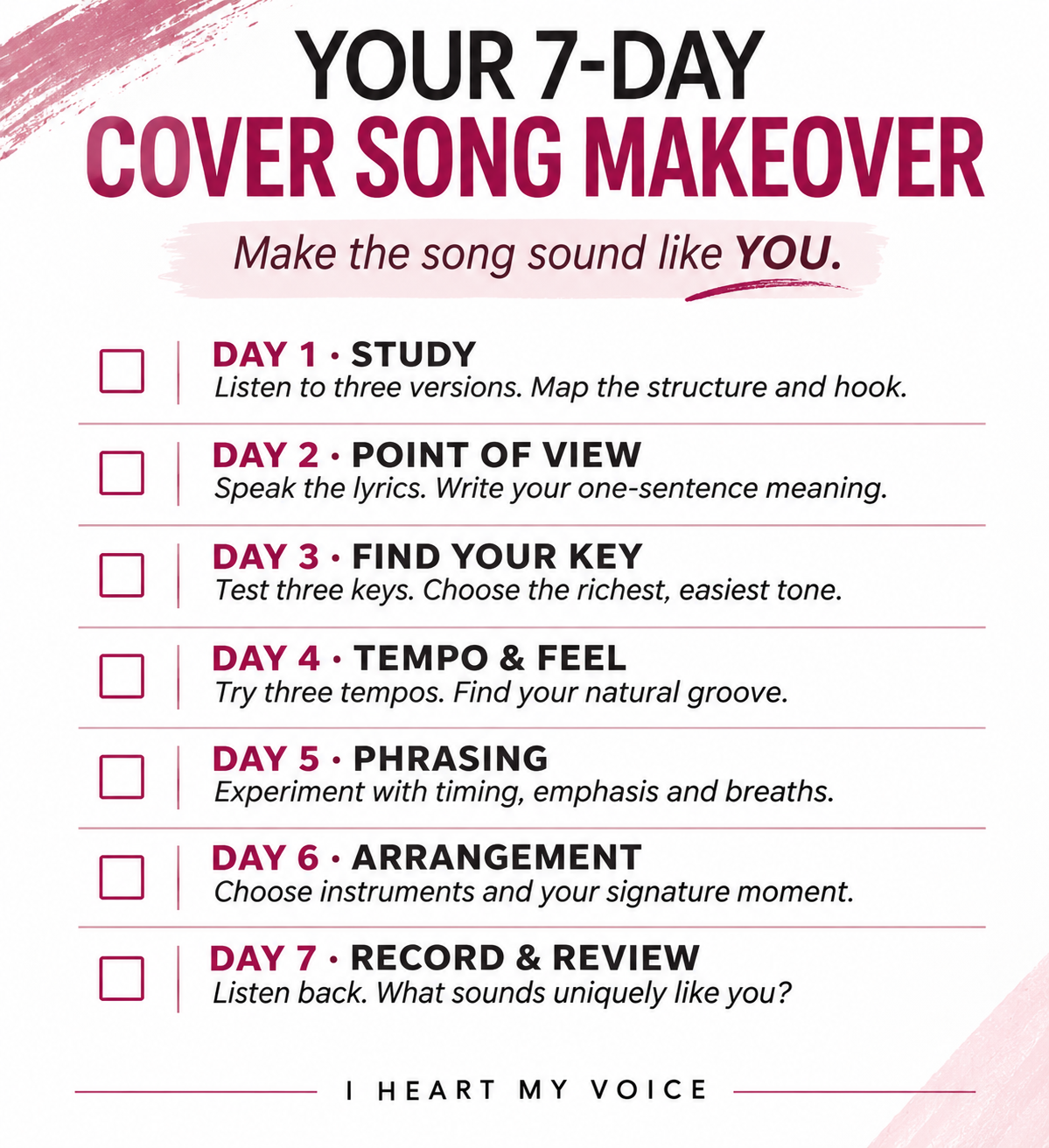
A 7-Day Plan to Rework Your Own Cover
Use this plan with any song you want to transform.
Day 1: Study. Listen to the original and two other versions, map the structure, and mark the hook.
Day 2: Point of view. Speak the lyric in your own words, record a voice memo, and write your one-sentence meaning.
Day 3: Key. Try the song in three keys and choose the one that gives you the richest tone with the least effort.
Day 4: Tempo and feel. Record the song at three tempos and pick the one that fits your point of view.
Day 5: Phrasing. Mark where you will land late, where you will speak a line, and where you will breathe in a new place.
Day 6: Arrangement and signature moment. Decide on your instrumentation, your intro and outro, and your one unforgettable moment.
Day 7: Record and review. Perform the song start to finish, record it, listen back, and note what sounds like you and what still sounds like the original.
Repeat the cycle with a new song, and you will start to see a pattern in the choices that feel most like you. That pattern is the beginning of your artistic identity.
Going Beyond Scales: How a Coach Helps You Develop Your Own Style
If you have already worked with a local teacher, you have built a foundation. You may also feel tired of repeating scales and basic exercises and wondering why you still do not sound like an artist. That frustration is a sign that you are ready for a different kind of coaching, one focused on style, brand, and mastery.
At I Heart My Voice, our signature Find Your Voice program was built for singers at that stage. Your coaching team helps you discover what makes your voice unique, choose songs that capture your superpowers, and develop the technique to deliver them with confidence. Our coaches are working industry professionals, and our team includes finalists from American Idol, The Voice, and X-Factor, so you learn from people who know what it takes to stand out.
Our studio motto sums up the whole idea: “No one will ever be better at being you and sounding like you than you, and that is your gift.” A cover song is one of the most powerful places to prove it. If you want to see how this approach works for singers in the city, read about finding your voice in LA and if you are stuck at a plateau, our article on why singers fail to grow explains what usually holds people back.
You can work with our team in person if you are looking for a vocal coach in Los Angeles or you can train online and receive the same personal attention.

FAQs:
-
Choose a song that fits your voice and your story, then change two or three elements of the original, such as the key, tempo, phrasing, tone, or arrangement. Keep the melody and hook recognizable, and sing the lyric from your own point of view.
-
Yes, you can make small changes to the melody, such as holding a note longer, shortening a phrase, or varying the ends of lines. Keep the main hook recognizable so listeners still know the song. Major changes to the melody or lyrics may require permission from the songwriter if you plan to release the recording.
-
Changing the key is optional, and many singers benefit from it. The original key was chosen for the original artist, and a key that suits your voice lets you sing with more ease and color. Try the song a half step or whole step higher and lower and choose the key where your tone sounds richest without strain.
-
A good cover is different enough that listeners hear your personality and similar enough that they still recognize the song. A helpful approach is to change two or three elements, such as the key, tempo, phrasing, or arrangement, and keep the hook intact.
-
Learn the song from the lyrics and melody, then stop listening to the original for a few days. Decide what the song means to you, change the key or tempo, and plan your own phrasing and ad-libs. Recording yourself and listening back helps you catch moments when you slip into imitation.
-
Pick a song with a lyric you can connect to, a range and style that show off your best qualities, and room to put your own spin on it. If a song is performed by many singers, make sure your angle is distinctive.
-
Rules depend on the platform and on how you share the recording. Many platforms have systems that allow covers, though the song’s owner may claim or monetize the video. Releasing a cover on streaming services generally requires a mechanical license. This is general information and not legal advice, so check the details for your situation.
-
A cover is any performance of a song written or recorded by someone else. An interpretation is a cover in which the singer changes elements such as phrasing, tone, key, and emotional angle so that the performance reflects their own artistry.
-
Yes. A coach can hear which habits are copied from other singers, help you find the tone and phrasing that suit you, and guide you toward songs that show off your strengths. At I Heart My Voice, developing a unique sound and brand is the focus of our Find Your Voice program.
❤️ Final Word from Roxie
Ready to Sound Like Nobody Else?
You already have a voice that no one else can copy. The next step is learning to use it with intention, so that every song you sing feels like an introduction to the artist you are becoming.
If you have taken lessons and you are ready for coaching that builds style, brand, and mastery, apply for the Find Your Voice program and let’s start building a sound that only you can make.
With love,
Roxie

At I Heart My Voice, we help singers unlock their full potential through online singing lessons, vocal coaching, and artist development programs.
Whether you’re just starting out or ready to go pro, our award-winning team has guided singers to Broadway, Disney, Nickelodeon, major labels, and viral success.