
By Roxie Francis, Founder of I Heart My Voice
The right song makes an average rehearsal sound like a record deal. The wrong song makes a gifted singer sound like she is wrestling a bear. Song choice is the quiet decision that shapes every audition, social clip, and gig you will ever do.
Here is the short answer. To choose songs that show off your voice, match each song to your comfortable range, your natural tone, and your strongest style. Then test it, record it, and adjust the key until the song sits like it was written for you.
The rest of this guide walks through that process one step at a time.
Why Song Choice Matters So Much
Casting directors, label reps, and your own audience decide within the first few seconds whether a voice feels special. A song that fits you gives them that answer fast. A song that fights you hides your best qualities behind effort, cracks, and nerves.
Our team at I Heart My Voice has seen this play out for two decades. We coached Victoria Justice for more than five years in Los Angeles to make her first recordings and prepare for the auditions that landed her the lead on Nickelodeon’s Victorious. We chose and recorded songs that showcased her voice instead of songs that simply sounded impressive. That strategy is the same one we teach every singer in our Los Angeles vocal coaching program, Find Your Voice.
Our studio motto says it best: no one will ever be better at sounding like you than you. Your song list should prove it.

Step 1: Find Your Real Vocal Range and Your Sweet Spot
Most singers know their highest note and their lowest note. Fewer singers know where their voice feels strongest, and that second answer matters more.
Your range is the full span of notes you can sing. Your tessitura is the stretch where your voice sounds richest and tires last. A song can fit inside your range and still sit far from your tessitura, which is why a song can feel technically possible and still sound strained.
You can find both with a simple check at the piano or with a keyboard app:
Start on a note that feels easy in the middle of your voice and sing a gentle five-note scale up and down.
Move the scale up one half step at a time until the sound turns tight or breathy, then note that pitch.
Return to your starting note and move down the same way until your tone loses its core.
Mark the notes where your voice feels warm and effortless. That zone is your sweet spot.
Voice types give you a rough map. Soprano voices commonly live around C4 to C6, mezzo-sopranos around A3 to A5, altos around F3 to F5, tenors around C3 to C5, baritones around G2 to G4, and basses around E2 to E4. Pop and R&B singers do not need to fit a classical label, but the map helps you see where your voice tends to sparkle.
Never push past a tight or painful note to measure your range. A healthy range is one you can sing without strain, and a coach can help you extend it safely.

Step 2: Learn Your Tone
Range tells you which notes you can reach. Tone tells you what those notes sound like. Two singers with identical ranges can sound completely different on the same melody.
Listen to a recording of yourself on a song you love and describe what you hear. Your voice may sound bright and sparkly, dark and velvety, airy and intimate, gritty and raw, or rich and powerful. Most voices blend two or three of these qualities.
Tone points you toward songs where that quality becomes the main attraction. A close, breathy tone shines in an intimate track like Billie Eilish’s “when the party’s over.” A full, rich voice thrives on the kind of big emotional ballad Adele made famous. A bright voice with quick agility feels at home in upbeat pop with fast melodic turns.
Choose songs that make your tone the star. If your voice is soft and smoky, a belt-heavy power ballad hides the best thing about you.

Step 3: Match Your Style and Genre
Genre tells the listener who you are before you sing a full line. Commercial pop, R&B, musical theatre, soul, indie, and singer-songwriter music each reward different strengths.
Musical theatre rewards clear storytelling and strong diction. Soul and R&B reward emotional color, runs, and a confident groove. Indie and singer-songwriter styles reward honesty and a distinctive voice. Commercial pop rewards hooks, rhythmic precision, and a polished sound that fits a short video clip.
Ask yourself which genre makes you feel most like yourself when you sing. Then ask which songs in that genre show the widest slice of your ability without stretching beyond it. Your best audition song sits at the overlap of what you love and what you do well.

Step 4: Check What the Song Demands
Before you commit, study the song like a coach would. A great song on paper can hide a dozen traps.
Check the total range of the melody. A song that spans two octaves asks for a different skill set than a song that stays within an octave and a half. Check where the melody lives most of the time, because a song that hangs near the top of your voice for three minutes will tire you out even if the highest note is easy.
Look at where the song crosses your break, the place where your voice shifts between registers. If the chorus sits right on that shift, you need solid mix voice skills to sing it smoothly. If you are still building that skill, pick songs that cross your break briefly and with room to prepare.
Check the demands beyond pitch as well. Fast runs, long sustained notes, heavy belting, and quick breaths between phrases all raise the difficulty. A song with relentless phrases and no pause for air will show your breath support, for better or worse.
Finally, check the story. A song only shows off your voice when you understand what you are saying. If the lyric does not match your life, your age, or your point of view, you will struggle to make a listener believe it.

Step 5: Test Drive the Song Three Times
Never judge a song after a single run-through. Give it a fair trial.
Sing it once at full volume in the original key to see where the trouble spots hide. Sing it a second time and concentrate on how your body feels, noting any spot where your throat tightens or your breath runs short. Sing it a third time while recording yourself on your phone.
Then listen back with a kind but honest ear. A song earns a spot on your list when you notice three things. Your tone sounds like your best self, your pitch stays steady, and you look relaxed in the video. If the recording makes you wince, the song needs a different key or a different spot on your list.

Step 6: Change the Key
Singers often treat the original key as a rule. It is only a suggestion.
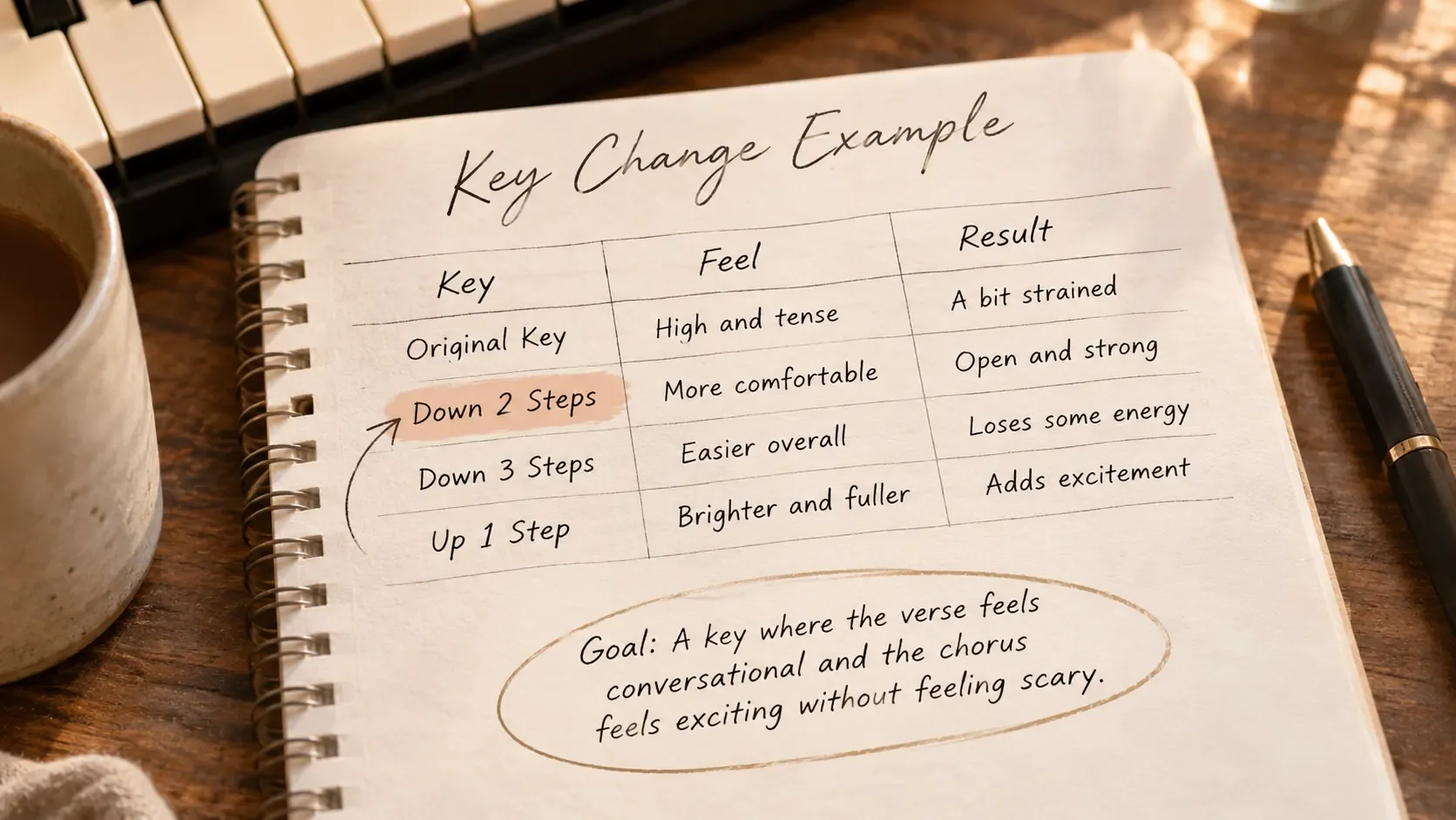
Artists change keys all the time to fit their own voices, and so should you. Moving a song down two steps can rescue a chorus that sat too high. Moving it up a step can add brightness to a verse that sounded muddy. Many singers find their ideal key within one to three half steps of the original.
A vocal coach or accompanist can transpose a song for you. A simple keyboard app also works for quick experiments. Your goal is the key where the verse feels conversational and the chorus feels exciting without feeling scary.
Step 7: Choose for the Moment
The perfect song for your living room is not always the perfect song for a callback. Think about where the song will live.
For an audition, choose a song that fits the style of the project and shows your strongest 16 or 32 bars. Pick a piece you can sing beautifully on a nervous day, because adrenaline pushes every singer higher and faster. Avoid songs that every other auditioner will bring, since a surprising choice sticks in a listener’s memory.
For social media, choose a song with a hook people already recognize, then give it your own spin. A cover that shows your style will earn more attention than a note-perfect copy. Singers in our community have grown audiences from a few hundred followers to six figures by pairing the right song with a clear musical identity.
For a gig, build a set that moves. Open with a song that feels easy, place your biggest showpiece in the middle, and close with a song the room can sing back to you. If you gig several nights a week, protect your voice by choosing songs that sit comfortably in your sweet spot.
For recording, choose songs that you can sing with ease at your best on take twenty. A microphone catches every strained note, and a relaxed performance sounds more expensive.

Signs a Song Is Wrong for You Right Now
Some songs are not wrong forever. They are only wrong today. Watch for these signals:
Your throat feels tight or scratchy after one run-through.
You avoid the chorus in practice because you dread the high part.
You can only sing it well once in a while and never twice in a row.
You are copying the original artist instead of singing the song your own way.
The song makes you shout, push, or tense your jaw to reach the notes.
Put those songs on a “later” list. As your technique grows, many of them will become signature numbers. A song that feels impossible in January can feel natural by June with the right training in breath support, mixing, and resonance.
Build a Signature Song List
Professional singers carry a small catalog of songs they can deliver on demand. Building yours takes an afternoon and pays off for years.
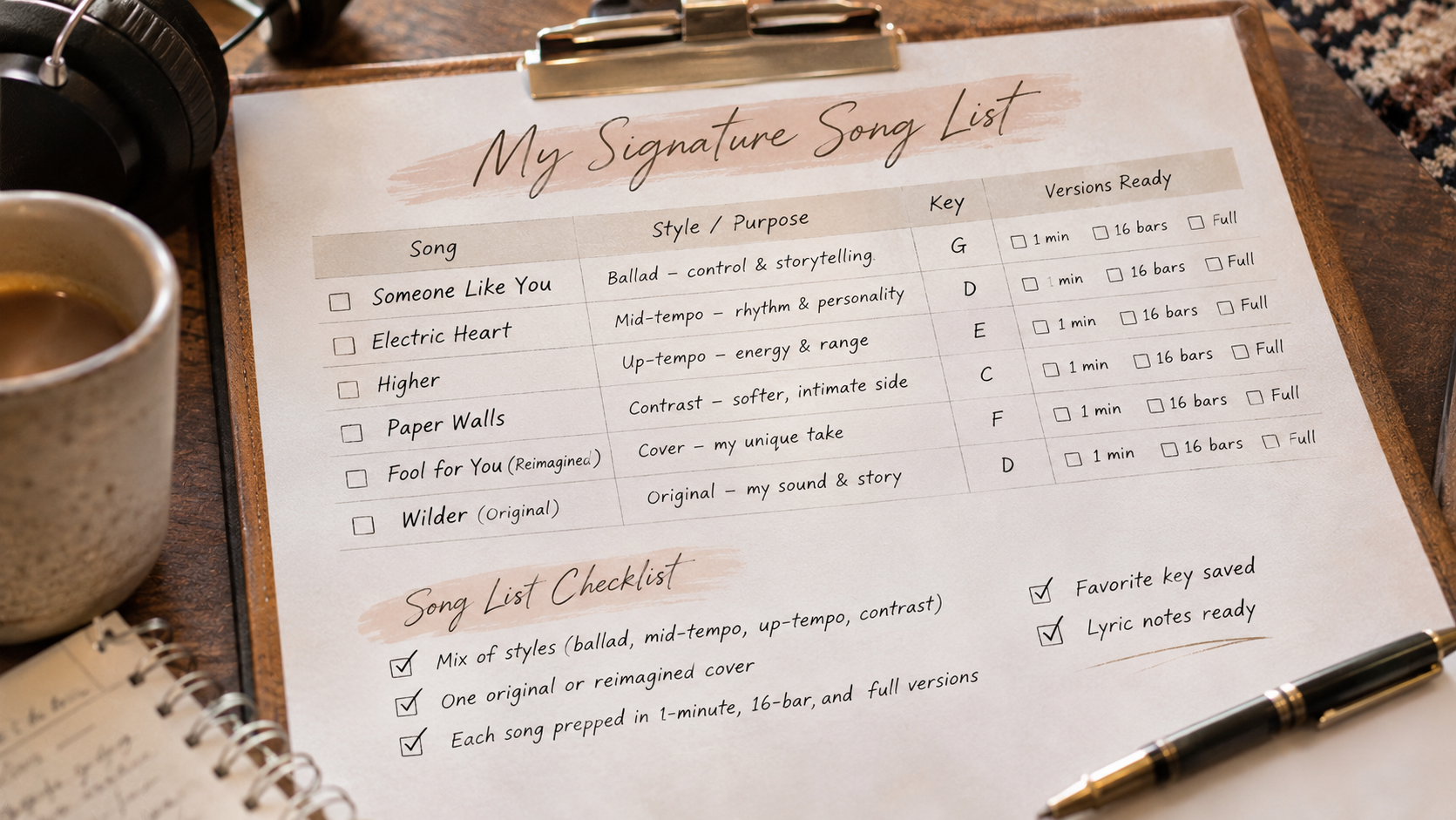
Aim for six to ten songs. Include a ballad that shows your control and storytelling, a mid-tempo song that shows rhythm and personality, an up-tempo number that shows energy, and a contrast piece that shows a different side of your voice. Add one original or reimagined cover that sounds like nobody else.
For each song, prepare a one-minute cut, a 16-bar cut, and a full version. Save your favorite key and your lyric notes in one place. When an audition lands or a gig opens up, you will already be ready.
If you want to take your catalog further with original material, our Viral Songs in 60 Days program helps you write songs designed around your own voice. Working artists who are already performing and releasing music can grow with our Thriving Singer coaching.
Common Mistakes to Avoid
Singers tend to stumble in the same few places. The first mistake is choosing a song because it is famous for a huge belted note, which turns your whole performance into a stress test for one moment. The second is picking a song because a friend loved it, since a friend’s voice may be nothing like yours. The third is skipping the recording step, because a mirror and a phone camera reveal what your ears miss in the moment. The fourth is refusing to change the key, which turns a doable song into a battle. The fifth is choosing songs only for technical flash, which leaves out the thing listeners remember most, your feeling.
When to Bring in a Coach
You can learn a lot on your own, yet a trained ear speeds everything up. A good coach hears your tone, spots your break, and knows within minutes which songs will make you shine. Technique work matters here too, because stronger breath support and a smoother mix voice open up song choices you cannot use today. Our Art of Singing program builds those technical skills one session at a time.
If you want a team that builds your song list around your voice, our coaches do exactly that. Every IHMV coach is a working industry professional, and many sessions run online so you can train from anywhere. You can learn more about working with a vocal coach in Los Angeles and the Find Your Voice program on our main coaching page.

FAQs:
-
Find your comfortable range, listen for your natural tone, and choose songs whose melody sits in your sweet spot. Test each song three times and record yourself. The songs that sound relaxed and distinctive on the recording are your best fits.
-
No. Many singers perform songs in a different key that suits their voice better. Moving a song up or down a few half steps can make the difference between a strained performance and a stunning one.
-
Choose a song that fits the style of the project, sits in your sweet spot, and shows your tone and personality within 16 to 32 bars. Pick something you can sing well even when you are nervous, and avoid songs that every other singer in the room will bring.
-
You can sing a song with a few notes outside your comfortable range if you transpose it or build the skills to reach them safely. Pushing past your limits without technique can strain your voice, so work with a coach when you want to expand your range.
-
Six to ten well-prepared songs covers most situations. Include a ballad, a mid-tempo song, an up-tempo number, a contrast piece, and an original or reimagined cover, with a short cut of each ready to go.
-
Yes. As your breath support, mix voice, and control grow, songs that once felt out of reach move onto your active list. Revisit your song list every few months and retire anything that no longer represents your best work.
❤️ Final Word from Roxie
Your Next Step
The songs you choose tell the world who you are before you finish the first verse. Pick the ones that make you sound like yourself on your best day, and let them do the talking.
If you are ready to build a song list around your one-of-a-kind voice, reach out to the IHMV team and start your journey.

At I Heart My Voice, we help singers unlock their full potential through online singing lessons, vocal coaching, and artist development programs.
Whether you’re just starting out or ready to go pro, our award-winning team has guided singers to Broadway, Disney, Nickelodeon, major labels, and viral success.